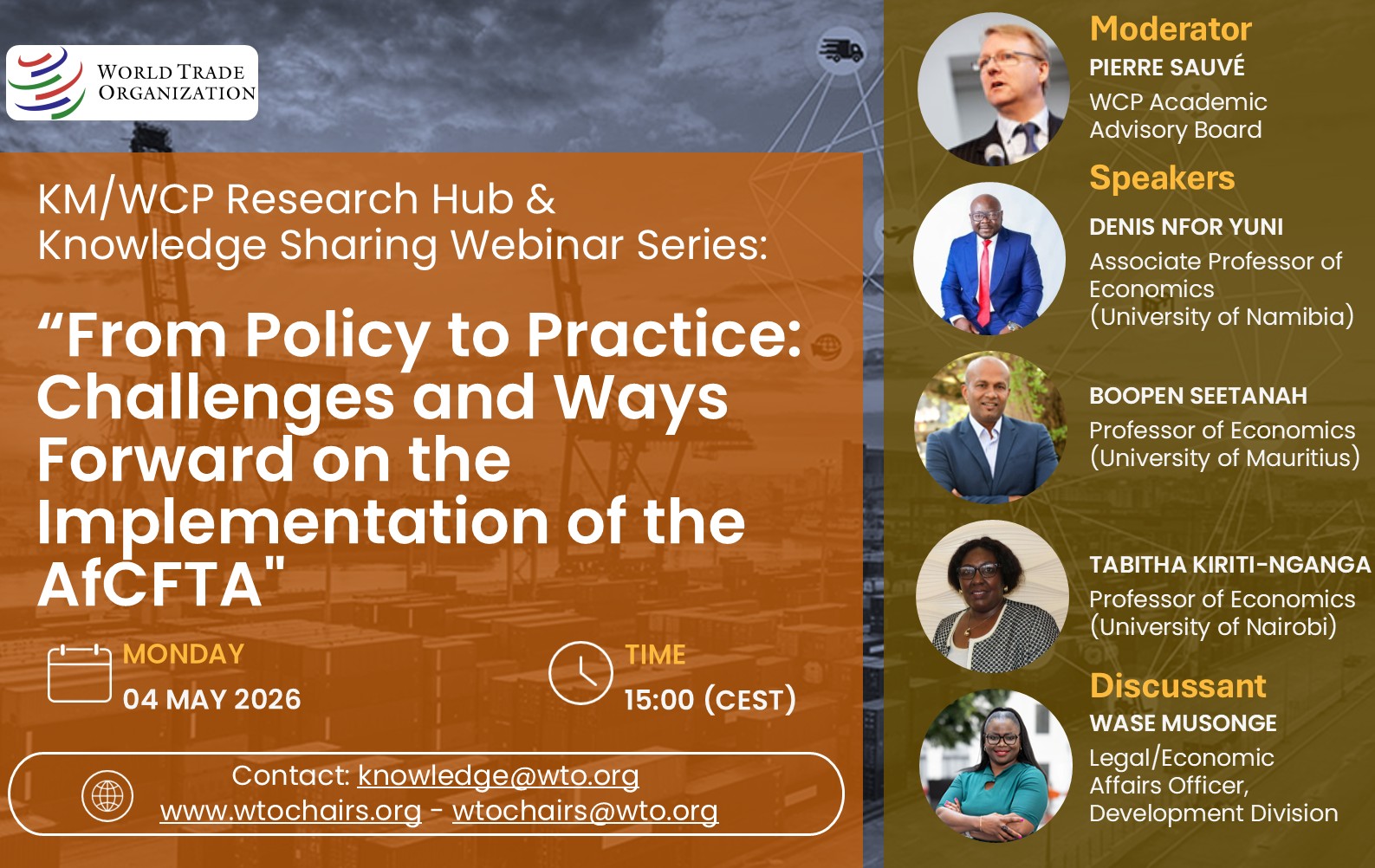
WCP holds Research Hub and Knowledge‑Sharing Webinar on AfCFTA implementation
The Lagos Plan of Action and Abuja Treaty serve as foundations for the AfCFTA, which is based on Africa's economic unification goal. Its five-year implementation is evaluated in this research, which also highlights opportunities, advancements, and problems for Nigeria and Africa. The AfCFTA, rooted in Africa’s economic integration agenda, builds on the Lagos Plan of Action and Abuja Treaty. This study assesses its five-year implementation, highlighting challenges, progress, and opportunities for Nigeria and Africa.
this study aims to examine the digital readiness of rwandan women entrepreneurs andits effect on business performance within the context of afcFta. the study employeda mixed-methods approach, including a cross-sectional survey on 94 rwandan womenentrepreneurs in cross-border trade across various sectors at key border points,complemented by interviews with stakeholders from several government and tradeorganizations.
This study investigates the transformative potential of the African Continental Free Trade Area (AfCFTA) in reshaping intra-African trade dynamics. Employing a gravity model approach, the research elucidates the complex trade relationships intrinsic to the African continent, highlighting the opportunities and growth prospects AfCFTA presents for economic advancement, trade efficiency enhancement and regional integration promotion.
This study assesses the effects of the African Continental FreeTrade Area’s (AfCFTA) and East African Community’s (EAC) mem-berships on export promotion and household welfare usingpanel data (1997 to 2020). Results reveal positively significanteffects of domestic investment, imports, consumption, politicalstability, and governance effectiveness on export growth, whilethe impact of regional membership on exports was inconclu-sive.
This workshop was convened to strengthen the capacity of East African Community (EAC) Partner States in implementing the AfCFTA Protocol on Investment and preparing for the negotiation of the Annex on Dispute Settlement. Organized by the EAC Secretariat with support from GIZ and facilitated by GOPA, the four-day workshop brought together 22 participants from seven EAC Partner States in Nairobi, Kenya.
The African Continental Free Trade Area (AfCFTA) represents a transformative initiative aimed at fostering economic integration, boosting intra-African trade, and promoting structural transformation across the continent. As the host of the AfCFTA Secretariat and an early ratifier of the agreement, Ghana is uniquely positioned to lead by example in its implementation. This assessment evaluates Ghana’s readiness to operationalize the AfCFTA, considering its economic structure, institutional capacity, and policy environment.
Le 21 mars 2018, à Kigali, au Rwanda, une étape majeure dans le processus d'intégration économique de l'Afrique a été franchie avec la signature de l'Accord établissant la Zone de libre-échange continentale africaine (ZLECAf) par 44 pays africains. Projet phare de l'Agenda 2063 de l'Union africaine (UA), cet accord gigantesque, déjà ratifié par 48 pays africains, ouvre une nouvelle trajectoire pour le développement économique de l'Afrique.
La Zone de Libre-Échange Continentale Africaine (ZLECAf) qui est opérationnelle depuis 2021 offre une opportunité pour booster le commerce digital africain et pour réaliser le Marché Unique Digital en Afrique. Dans cette perspective, le protocole sur le commerce digital en cours de négociations fait l’objet de toutes les attentes pour l’édification d’un cadre règlementaire propice et harmonisé. L’objectif de cette étude est donc d’analyser l’écosystème règlementaire du commerce digital en Afrique.
Prof. Manfred Kouty, Co-Chair attended the first conference on AfCFTA Implementation Strategies: Towards an AfCFTA Implementation Peer Learning Community that took place in Nairobi, Kenya, from 15 to 17 January 2024, co-organized by The United Nations Economic Commission for Africa (ECA), in collaboration with the AfCFTA Secretariat and the United Nations Development Programme (UNDP).