
The 3rd "My Proposal for WTO Reform" Competition Symposium Concludes in Shanghai
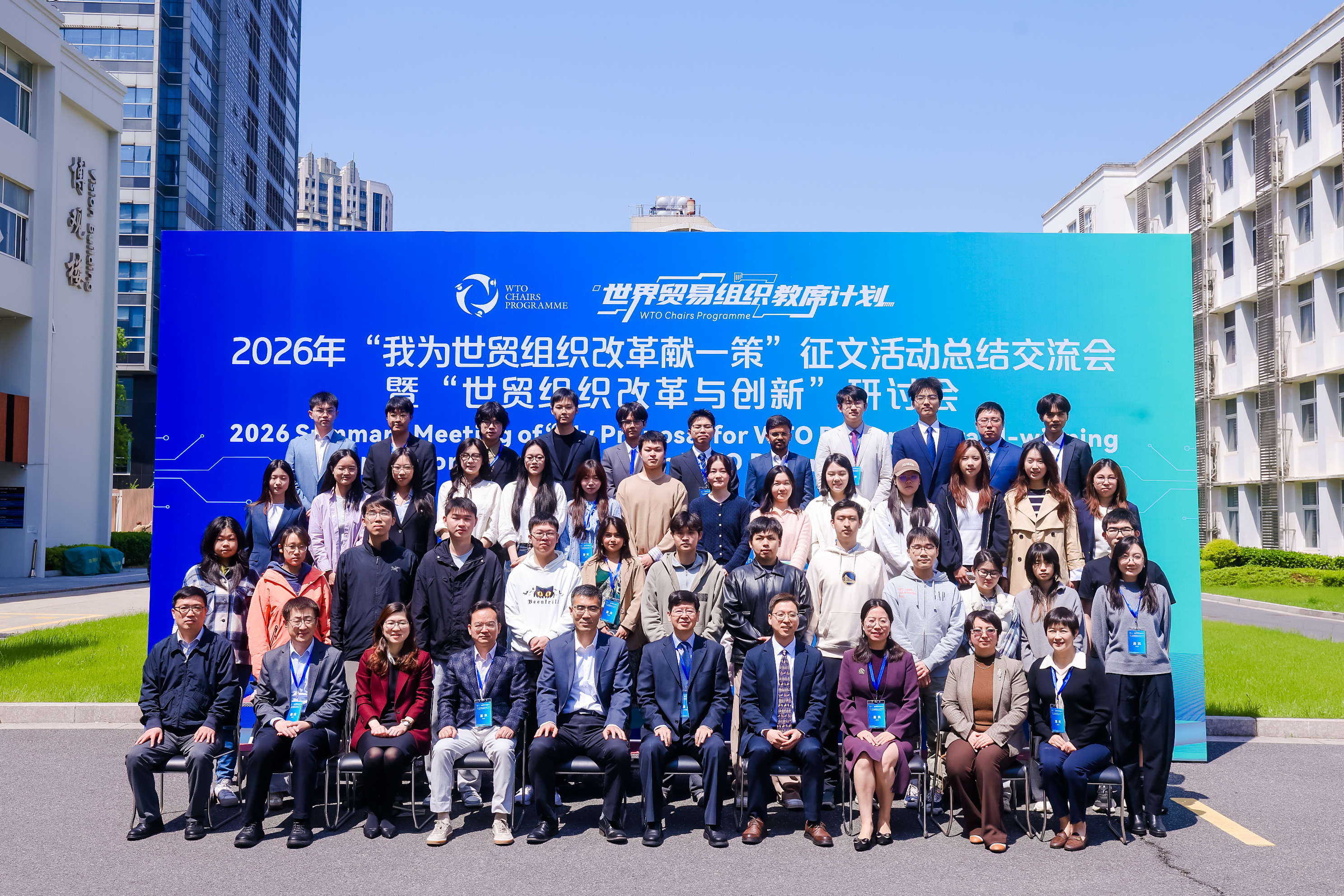
The 3rd "My Proposal for WTO Reform" Award-winning Competition, organized by Shanghai University of International Business and Economics (SUIBE) and University of International Business and Economics (UIBE) under the guidance of the Ministry of Commerce of the People's Republic of China, concluded with symposium on WTO reform and innovation on 24 April 2026 at SUIBE in Shanghai.
Held on the occasion of the 25th anniversary of China's accession to the WTO and following the conclusion of the 14th WTO Ministerial Conference (MC14), this year's competition marked a significant milestone as it is the first time to adopt an all-English format and open to participants worldwide. It attracted nearly 100 submissions from universities and research institutions around the world, focusing on cutting-edge issues in WTO reform including negotiation and decision-making mechanisms, security exceptions, the Most-Favored-Nation (MFN) principle, industrial policy, etc.
A total of 30 outstanding proposals were selected, with 3 first prizes, 6 second prizes, 10 third prizes, and 11 honorable mentions. Notably, participants from the University of Delhi (India), Kathmandu University (Nepal), and Tashkent State University of Law (Uzbekistan) received prizes, demonstrating the growing international influence of the competition.
In opening remarks, Dean Pinguang Ying of SUIBE highlighted the long-standing partnership between SUIBE and WTO, noting that the competition has become a key platform for fostering young talent in global trade governance. He emphasized that this competition, open to faculty and students from universities worldwide, aligns with the multilateral nature of the World Trade Organization, and encouraged all parties to contribute diverse perspectives on reform initiatives.
Dean Xinquan Tu of UIBE's China Institute for WTO Studies emphasized the importance of situating WTO reform within the broader context of global order restructuring. He encouraged young scholars to develop innovative solutions that address the evolving challenges facing the multilateral trading system.
Chen Wang, Director of the Department of WTO Affairs at China's Ministry of Commerce provided an overview of the outcomes of MC14, highlighting China's role in advancing the Investment Facilitation Joint Declaration and the provisional implementation arrangement for the E-Commerce Agreement. He called on the academic community to continue providing intellectual support for the WTO reform.
The symposium featured three thematic sessions covering core reform priorities:
1. WTO Institutional Reform and the Most-Favored-Nation Principle
2. WTO Development and Security Issues
3. Trade Balance, Export Controls and Industrial Policy
Presenters from China, India, Nepal, and Uzbekistan shared their research findings, which were discussed and evaluated by leading experts including Xiaodong Hong, former Director-General of the Department of WTO Affairs at China's Ministry of Commerce; Xinquan Tu, Dean and Professor of the China Institute for World Trade Organization Studies at the UIBE and WTO Chairs Programme (WCP) Chair Holder; Professor Baihua Gong from the School of Law of Fudan University; Professor Wenhua Ji, WCP Co-Chair Holder of UIBE; and Prof. Haifeng Wang, Director and Research Professor of the International Law Office at the Institute of Law, Shanghai Academy of Social Sciences.
In concluding remarks, Mr. Hong praised the significant improvement in the quality of submissions this year, and emphasized that the competition provides a practical platform for university students and faculty to contribute to global economic governance.
Mr. Harish Iyer, Head of the WTO Chairs Programme Unit from ITTC, WTO, delivered the closing address via online. He commended the collaboration between the two Chinese WTO Chair institutions as a model of academic engagement with the WTO. He clarified that WTO Chairs Programme will continue to support such academic exchanges and advance global research on WTO reform.
The success of the 3rd "My Proposal for WTO Reform" Competition underscores the critical role of academic collaboration in shaping the future of the multilateral trading system. It also demonstrates China's commitment to supporting WTO reform and promoting inclusive global economic governance.