
WTO Chairs Programme holds Asia Network webinar on economic integration in Asia
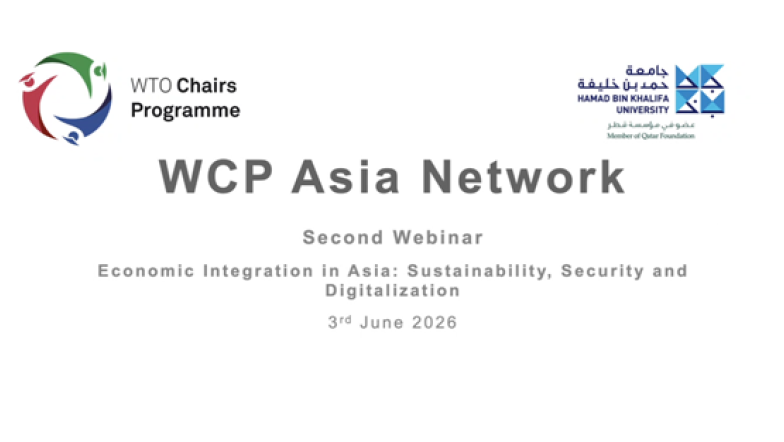
The WTO Chairs Programme (WCP) held the second Asia Network webinar on 3 June 2026, bringing together Chairholders, researchers, and experts to discuss “Economic Integration in Asia: Sustainability, Security, and Digitalization.” The webinar was organized under the auspices of the WCP Chair in Qatar at Hamad Bin Khalifa University (HBKU), acting as the Coordinator of the WCP Asia Network in 2026.
The event formed part of WCP efforts to strengthen regional collaboration, knowledge-sharing, and academic dialogue on trade related topics. Building on the momentum of the first webinar, this second session further advanced discussions on the changing nature of economic integration in Asia, particularly in the context of rapid digital transformation and evolving global economic dynamics.
Osman Gulseven, the WCP Chairholder in Oman, presented research on the relationship between oil dependence and trade integration in the Arab world. Using a gravity model, his analysis highlighted structural constraints affecting diversification and underscored the challenges faced by resource-dependent economies in deepening regional trade integration.
Amna Zaman, Doctoral Fellow at the Qatar WCP Chair, examined the intersection of digitalization and sustainability, with a focus on workers’ rights in Asia’s digital economy. She noted the rapid expansion of digital trade alongside the limited development of labour protection for digital workers. Her presentation emphasized the disconnect between digital trade provisions and labour provisions in current trade agreements, as well as the absence of unified regulatory frameworks and the persistence of governance structures rooted in the pre-digital era.
Usman Ali Khilji, Head of the Regional Desk for Asia-Pacific in the WTO’s Institute for Training and Technical Cooperation, presented evidence on digital integration in Asia through the lens of regional trade agreements. His analysis highlighted the significant variation in digital trade provisions across agreements and demonstrated how differences in design can influence the depth and effectiveness of regional digital integration.
Wenjuan Ma, Research Fellow at the Qatar WCP Chair, addressed the role of digital identity frameworks as a critical component of economic integration. She underscored the importance of harmonizing digital identity systems across countries and highlighted key challenges related to cybersecurity, trust and interoperability, despite growing internet penetration and technological maturity in several parts of Asia.
The webinar concluded with a discussion on ongoing research and future collaboration opportunities. Participants expressed strong interest in joint work on digital integration and sustainability, as well as further analysis of regional trade agreements.
Looking ahead, the Asia Network announced plans for two additional webinars and a forthcoming call for papers for students focusing on WTO reform from Asian perspectives. Selected finalists will have the opportunity to present their research at one of the webinars later in the year.